 Northern Prairie Woodworks
What Is an End Grain Butcher Block? A Maker’s Guide
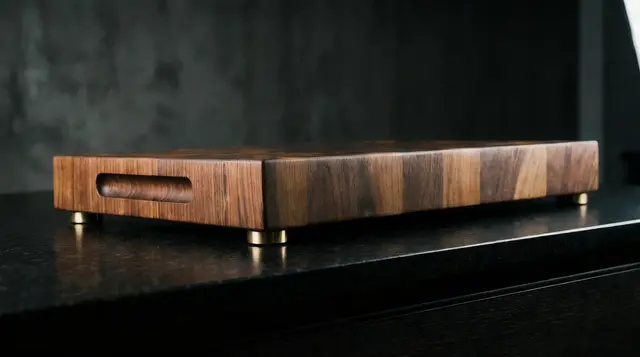
An end grain butcher block is a cutting surface built from hardwood stood on end, so the face you cut on shows the tips of the wood fibers instead of their long sides. Picture a tight bundle of straws pointed straight up at you. That one structural choice is the reason these boards behave so differently from everything else in the kitchen. I build them one at a time in my Virden, Manitoba shop, and they are the toughest boards that leave my bench. Below I cover what sets an end grain butcher block apart, why it lasts, and how to keep yours going for decades.
How an end grain butcher block is built
Most boards in stores are edge grain, which means the long sides of the wood face up. An end grain butcher block flips that orientation. First I mill the hardwood into strips and glue them into a panel. Then I crosscut that panel and stand every piece on its end. After a second glue-up and a long flattening pass, the surface becomes a checkerboard of fiber ends. Because your knife now meets the tips of the fibers rather than their sides, the edge slips down between them instead of scraping across them. If you want the deeper science, I wrote a plain-language explainer on what end grain actually means. The build takes more time, and the finished board earns every minute of it.
Why an end grain butcher block lasts for decades
Three things make this style outlast a regular board. First, it stays gentle on your knives. Since the edge settles between the fibers, it dulls far slower than it would on hard edge grain or plastic. Second, the wood self-heals. After a cut, the fibers swell back toward each other once the board is cleaned and oiled, so the surface closes over small marks rather than scarring. Finally, the construction is simply stronger. A thick end grain butcher block shrugs off cleaver work, a whole squash, and a full holiday prep session that would wreck a thinner board. As a result, a well-kept block genuinely outlives the kitchen it started in.
Choosing the right wood and size
I build most blocks from Canadian hardwoods, usually hard maple, walnut, and cherry, because they hit the sweet spot of density and grain. Maple gives you a bright, even surface that takes engraving cleanly. Walnut runs darker and richer, and it drinks the oil until the grain turns the color of dark honey. For size, start with how you actually cook. A compact block suits a smaller counter and everyday slicing, while a larger piece like the Maple Boreal, 20×12 handles serious prep and doubles as a serving centerpiece at the table. You can see the current run on the end grain butcher blocks page. Each one is a one-of-one, so when it ships, it is gone.
How to care for your end grain butcher block
Good care is simple, and it makes all the difference. Wash the board by hand with warm, soapy water, then stand it on edge to dry so air reaches both faces. Never run it through the dishwasher or leave it to soak. Every few weeks, work in a food-safe finish. I use a blend of mineral oil and beeswax, and I sell the same conditioner as Board Butter. The oil keeps the wood from drying and cracking, while the wax adds a water-beading layer on top. For the full routine, here is my complete cutting board care guide. Stay on top of this and your end grain butcher block will hold flat, stay sanitary, and look beautiful for years.
Every board is built by me, one at a time, on the Canadian prairie in Virden, Manitoba, then finished by hand and shipped across Canada and the United States. If you would like one sized or engraved for your own kitchen, reach out any time.
Not seeing the piece you're picturing?
Memento boxes, shadow boxes, a board built around a shape, a custom-sized Compass block — most of what leaves this shop started as someone reaching out. Tell me what you have in mind and I'll come back with ideas and a price. No payment, no account.
Tell me what you're picturing →