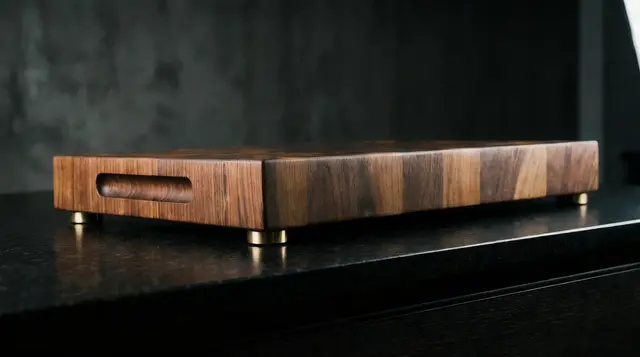
Choosing between a maple vs walnut cutting board comes down to a few honest tradeoffs: how the wood feels under a knife, how it ages, what it costs, and which one suits your kitchen. Both are excellent, food-safe hardwoods that will last for decades with a little care. Neither is a wrong answer. But they behave differently enough that knowing the differences ahead of time helps you land on the board you’ll actually reach for every day.
At Northern Prairie Woodworks, every board is built by hand here in Virden, Manitoba, from solid hardwood meant to be passed down rather than replaced. So here is the plain-spoken comparison we’d give you if you were standing in the shop.
Hardness and Durability: Maple Holds Its Edge
The clearest difference between the two woods is density. Hard maple (also called sugar or rock maple) sits around 1,450 lbf on the Janka hardness scale, which makes it one of the harder domestic hardwoods you can put in a kitchen. Black walnut comes in noticeably softer at roughly 1,010 lbf. Both are still firmly in the ideal range for cutting boards, but that gap matters in practice.
Because maple is harder, it resists denting and stands up to heavy daily chopping a little better. It’s the workhorse choice if your board lives on the counter and earns its keep. Walnut is still plenty durable for a lifetime of use, but its softer surface will show wear marks a touch sooner. The upside of that softness comes next.
Knife-Friendliness: Walnut Is a Little Gentler
If you’ve invested in good knives, walnut has a quiet advantage. A softer surface gives slightly when the blade meets it, so walnut tends to be a bit kinder to your edges and can help knives hold their sharpness a little longer between honings. Maple’s hardness, while great for durability, is marginally tougher on a blade, so you may find yourself touching up your edge a hair more often on a maple board.
The difference is real but modest. Both woods are closed-grain, which is the property that makes them genuinely well suited to food prep. A closed-grain hardwood has a tight cell structure that resists moisture and limits how deep bacteria can settle, which is why hard maple and walnut are both considered safe, hygienic choices for the kitchen. You’re not trading away food safety either way; you’re choosing between durability-first and edge-first.
Looks and How Each Board Ages
This is where many people simply decide with their eyes. Maple is pale and blond, a clean cream-to-light-honey tone that brightens a kitchen and shows off knife work, herbs, and bread beautifully. Walnut is the opposite end of the palette: rich, deep chocolate brown with the kind of grain that makes a board look like furniture.
Colour also affects how each board wears. Walnut’s dark tone naturally camouflages minor knife marks and the occasional stain, so it can keep looking pristine for years and doubles nicely as a serving or charcuterie board. Maple, being light, tends to reveal fine scratches and the discolouration from beets or berries more readily — even though it’s the harder wood underneath. So there’s a small irony worth knowing: walnut is softer but often looks newer for longer, while maple is tougher but wears its history more visibly. If you want to dig deeper into grain direction and species, our guide to choosing a cutting board wood is a useful companion read.
Price and Availability
Budget often settles the maple vs walnut cutting board question on its own. Hard maple is widely available across North America and generally the more affordable of the two, which is part of why it’s the classic butcher-block standard. Walnut is the premium pick: it’s pricier as raw lumber and tends to cost more as a finished board. You’re paying for that unmistakable dark grain and the furniture-grade presence it brings to a counter or table.
If you want maximum durability and value, maple is hard to beat. If you want a showpiece that’s a little gentler on knives and reads as elegant, walnut earns its higher price.
Caring for Either Board Is the Same
Here’s the reassuring part: maintenance doesn’t change based on which wood you choose. Whether you go maple or walnut, the routine is identical — hand wash with mild soap, never soak it or run it through the dishwasher, dry it flat, and oil it periodically with a food-safe mineral oil or board butter to keep the wood nourished and water-resistant. Treated this way, both woods will serve you for a generation. For the full routine, see our wooden cutting board care guide.
So, Which Should You Choose?
There’s no universal winner in the maple vs walnut cutting board debate, only the right fit for you. Choose maple if you want the hardest, most affordable, brightest board that shrugs off heavy daily chopping. Choose walnut if you want a softer, knife-friendly surface, a darker tone that hides wear, and a board that looks as good on the table as it does on the counter. Many cooks eventually keep one of each — and a number of our boards pair the two woods together precisely because their strengths complement each other.
Whichever way you lean, a solid hardwood board built by hand is an heirloom you’ll use every single day. You can see the maple and walnut boards we’re building right now in our cutting boards collection.
Want more plain-spoken guides like this, plus first looks at new boards as they come off the bench? Sign up for the Northern Prairie Woodworks newsletter and stay in the shop.