
Why End Grain
There’s a reason professional kitchens, serious home cooks, and butcher counters all reach for the same style of wood surface. End grain. It’s the strongest, longest-lasting, most knife-friendly way to build a cutting board or a butcher block. (See our handcrafted end grain butcher blocks if you want to skip ahead.) It’s also the hardest to make — which is why most mass-market boards aren’t end grain at all.
This page is a short, honest guide to what end grain is, why it matters, and how to choose the right board for the work you’re actually going to do with it.
What End Grain Actually Means
Wood has three directions of grain — face grain (the flat side of a board, the way most furniture is built), edge grain (the long, narrow side), and end grain (the cut ends of the board, where you can see the tree’s growth rings).
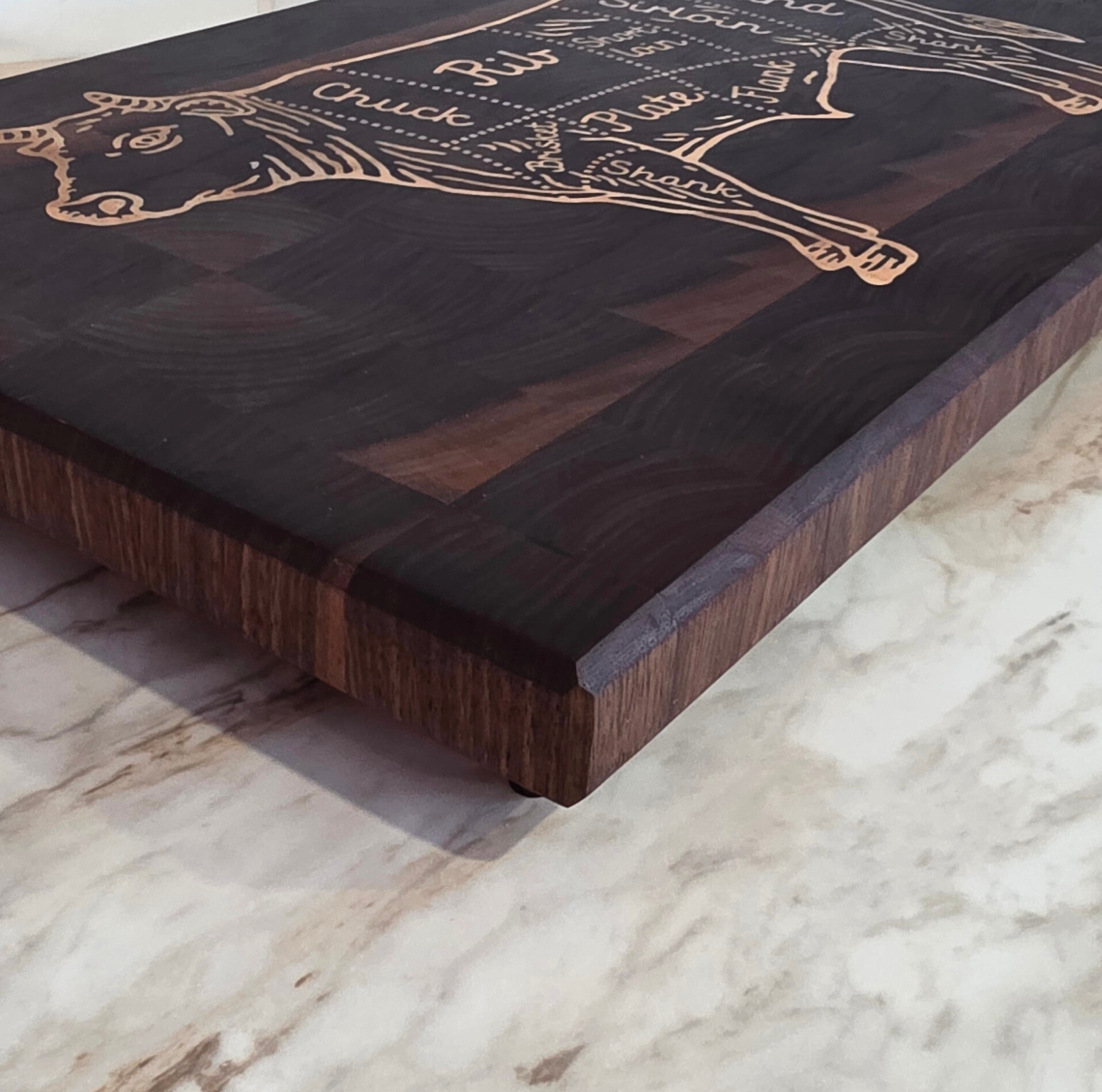
End grain construction takes short blocks of hardwood and stands them on end, so the growth rings face up. Then dozens — sometimes hundreds — of those blocks are glued together into a single surface. The result looks like a checkerboard of hardwood, because you’re seeing every tree’s fingerprint at once.
That orientation is the whole point. When a knife hits end grain, the blade slides between the vertical fibres instead of slicing across them. The board acts less like a cutting surface and more like a forest of soft bristles that part for the blade and close again behind it.
End Grain vs Edge Grain — The Real Difference
Both end grain and edge grain are strong hardwood surfaces. They’re both food-safe, both beautiful, both built to last. But they solve different problems.
Edge grain boards are easier to build, lighter, and less expensive. They’re the right choice for everyday prep work — slicing vegetables, breaking down a weeknight meal, any job where the board is a working tool rather than a centerpiece. Northern Prairie’s Hearth Series is edge grain.
End grain boards are harder to build, heavier, and more expensive — because a single piece has more species-matched cuts, more glue-ups, more planning, and more finish work than an equivalent edge grain board. In exchange you get:
- Knives that stay sharp longer. The blade doesn’t slice across the fibres; it parts them.
- A self-healing surface. Cuts that would scar an edge grain board close back up in end grain. A properly cared-for end grain board can still look clean after twenty years.
- Mass. End grain boards are thicker and heavier. They sit where you put them. They don’t slide.
- Presence. End grain has a visual depth edge grain can’t replicate — you’re seeing the inside of the tree.
For cooks who prep every day, who own good knives, or who want to buy one board for good, end grain is the answer.
Butcher Block — What It Actually Means
“Butcher block” is a term that’s gotten loose in the market. A butcher block is specifically a durable, thick hardwood surface made by gluing pieces of wood together — traditionally for butchering meat, but the definition has broadened to mean any heavy-duty hardwood prep surface. High-quality butcher blocks are at least 1.5 inches thick, often thicker.
Almost every true butcher block is end grain. The reasons are the ones above — thickness gives the board mass, and end grain gives it the knife-friendly, self-healing surface a butcher’s work demands.
Northern Prairie’s end grain boards at 1.5 inches and up qualify as butcher blocks in the real sense of the word: the Frontier XXL Relief in acacia, the Boreal Relief in walnut with zebrawood inlay, and the Compass Round in walnut are all full-weight butcher blocks, built the way the name implies.
Browse the Butcher Block collection →
The Process Matters
Every Northern Prairie board begins with hand-selected rough hardwood — chosen for structure, stability, and grain character. Each piece is milled flat and square, glued up with precision, planed, sanded through progressive grits, and finished by hand using an in-shop mineral oil and beeswax finish.
Nothing is mass-produced. Nothing is outsourced. The work happens one board at a time in a shop in Virden, Manitoba, and every board passes through the same pair of hands from rough lumber to finished piece.
That’s slower than the mass market. It’s also the only way to build something meant to be passed down.
How to Care for an End Grain Board
A cared-for end grain board outlasts its original owner. The rules are simple:
- Hand wash only. Warm water, a cloth, mild soap if needed. Never the dishwasher.
- Never soak. Wood and standing water don’t get along.
- Dry on its edge. Air-drying on a flat surface traps moisture underneath.
- Re-oil regularly. Every 3–4 weeks for daily-use boards, monthly for weekend boards. Mineral oil or a purpose-made board conditioner. When the wood stops drinking the oil, you’ve done enough.
- Resurface if you ever need to. After years of use, a light sand and re-oil resets an end grain board to near-new. This is the advantage of a thick glue-up — the board can be renewed.
A well-kept end grain board is the only cutting board you’ll ever need to buy.
Start the Collection
Every Northern Prairie cutting board and butcher block is built one at a time in Manitoba, finished food-safe, and shipped across Canada and the US.
Made to be Passed Down.
For deeper background on the science of wood grain orientation, the Wood Database’s entry on end grain cutting boards covers the cellular structure in detail. The short version: the cross-section behaves like a bundle of straws, opening and closing around the knife rather than splitting along it.